
Do you wake up with a sore jaw, or catch yourself clenching your teeth at the computer? It may be bruxism. It affects many adults, and most of them do not notice it for a long time. Here is how to recognize it, where it comes from and what you can do about it.
Contents
What is bruxism?
According to an international expert consensus, bruxism is repetitive jaw-muscle activity. It means clenching or grinding the teeth, or bracing or thrusting the lower jaw.
On its own, it is not always a disorder. For many people it is a habit that causes no trouble. It becomes a problem when it causes pain, wears down the teeth or overloads the jaw joints.
Sleep bruxism and awake bruxism
Doctors distinguish two forms of bruxism:
- Sleep bruxism happens during sleep. It often involves grinding that a partner can hear. The person grinding usually knows nothing about it.
- Awake bruxism is mostly clenching the teeth and tensing the jaw, usually without grinding. It shows up at the computer, behind the wheel, under stress and during intense focus.
A 2013 review of studies estimated that awake bruxism affects 22 to 31% of adults and sleep bruxism about 13%. Both forms can occur in the same person, but they have somewhat different causes and call for different approaches.
Symptoms of bruxism
Bruxism can go without symptoms for a long time. When they appear, the most common are:
- pain or fatigue in the jaw muscles, especially in the morning or at the end of the day,
- headaches around the temples,
- worn, flattened or chipped teeth and cracks in the enamel,
- teeth that are sensitive to cold and heat,
- pain, clicking or popping in the jaw joint, just in front of the ear,
- difficulty opening the mouth wide,
- tooth marks along the edges of the tongue or a white line on the inside of the cheek,
- enlarged masseter muscles that make the lower face look wider.
None of these symptoms proves bruxism on its own, because other conditions can cause them too. That is why it is worth showing them to a dentist.
Causes of bruxism
Bruxism rarely has a single cause. Today it is thought to depend mainly on the nervous system, stress and sleep rather than on the shape of the teeth. The most common factors are:
- stress, tension and anxiety, especially in awake bruxism,
- sleep problems such as snoring and obstructive sleep apnea,
- stimulants: nicotine, alcohol and a lot of caffeine,
- some medicines, including certain SSRI antidepressants,
- gastroesophageal reflux, which is linked to sleep bruxism,
- family history, as sleep bruxism tends to run in families.
Bite problems used to be seen as the main cause. We now know their role is small, which is why grinding down the teeth to adjust the bite is not a recommended treatment for bruxism.
How is bruxism diagnosed?
A dentist diagnoses bruxism. It starts with a conversation about your symptoms and an examination: the dentist looks at your teeth and checks muscle tension and how your jaw moves. If sleep bruxism is suspected, they may order a sleep study (polysomnography) that records muscle activity at night.
Awake bruxism is harder to catch at the dentist’s office because it happens in everyday situations. Researchers use a method called EMA (ecological momentary assessment): a few times a day, they ask what the jaw is doing right now. These short answers show how often and at what times clenching happens.
Treatment of bruxism
No single method makes bruxism go away. Treatment aims to protect the teeth, reduce pain and cut down on clenching, so it usually combines several approaches.
Night guard (occlusal splint)
A splint worn at night protects the teeth from wear and takes load off the muscles. Ideally, a dentist makes it to measure. It does not remove the cause of bruxism, but it limits the damage.
Physical therapy
A physical therapist relaxes tight jaw and neck muscles and teaches exercises and a relaxed jaw position. This helps most when bruxism comes with pain.
Stress and sleep
Relaxation techniques, breathing exercises, physical activity and good sleep habits lower overall tension. If you snore or suspect sleep apnea, talk to a doctor. Treating sleep problems can reduce sleep bruxism.
Botulinum toxin
For severe pain or enlarged muscles, a doctor may consider botulinum toxin injections into the masseter muscles. They reduce clenching force for a few months. This is a medical decision, not a first-line treatment.
What you can do yourself
For awake bruxism, awareness matters most. It is hard to stop clenching if you do not notice when you do it.
- Learn the jaw’s resting position. Lips relaxed, teeth apart, tongue resting gently against the roof of the mouth. Teeth should touch mainly when you eat and swallow.
- Check your jaw a few times a day. When you catch yourself clenching, let go of your teeth, drop your shoulders and breathe out slowly.
- Take one-minute breaks. Massage your jaw muscles, loosen your neck and take a few calm breaths.
- Cut down on caffeine, alcohol and nicotine, especially in the evening.
- Skip chewing gum and pen biting. They put extra load on the jaw muscles.
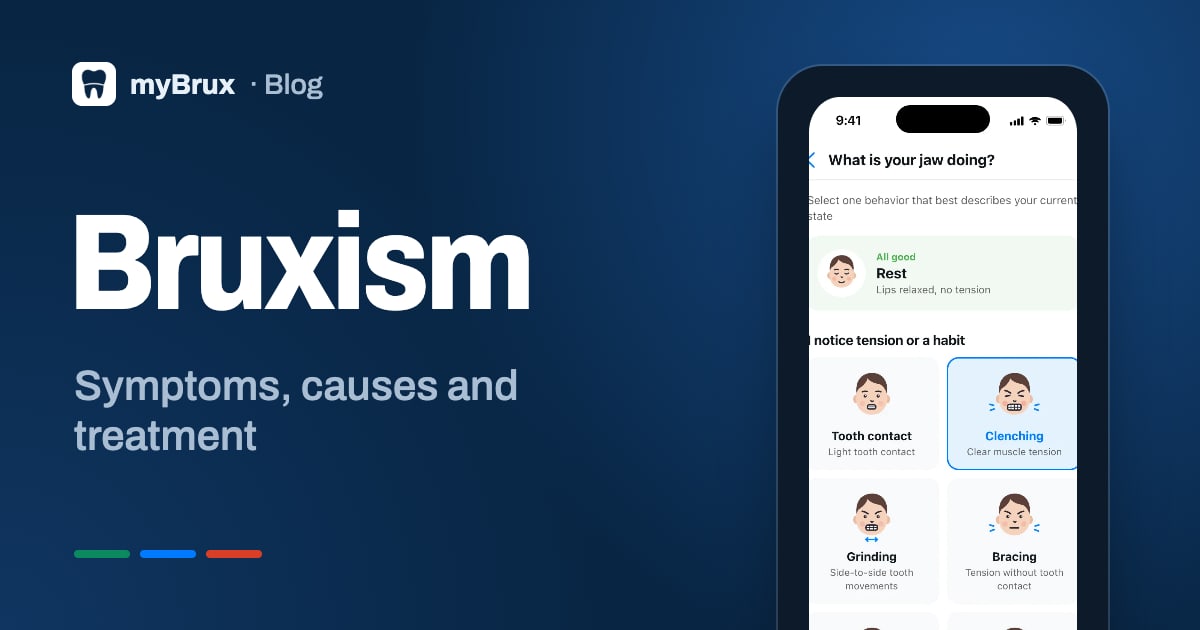
How myBrux helps. A few times a day, during the hours you choose, the app asks what your jaw is doing. You answer with a single tap. Over time you see at what times tension builds, and short relaxation exercises are ready in the app. myBrux does not treat bruxism, but it helps you notice it. See how it works.
When to see a dentist
Make an appointment with a dentist if:
- your jaw or face muscles hurt often or for more than a few weeks,
- your teeth are worn, chipped or sensitive,
- your jaw locks or clicks, or it is hard to open your mouth wide,
- you often wake up with a headache,
- someone hears you grinding your teeth at night.
If you also snore loudly or stop breathing for moments during sleep, tell your doctor. These can be signs of sleep apnea.
Frequently asked questions
Can bruxism be cured?
It usually cannot be switched off for good, but it can be kept well under control. A splint protects the teeth, physical therapy eases pain, and working on habits and stress reduces clenching.
Is bruxism dangerous?
It is not life-threatening. Left untreated, though, it can lead to worn and cracked teeth, muscle pain, headaches and jaw joint problems.
Is a night guard enough?
A night guard protects your teeth at night, but it does nothing about clenching during the day. Awake bruxism calls for work on the habit and on awareness.
Do children get bruxism?
Yes. Grinding at night is fairly common in children and often goes away on its own. It is still worth showing to a pediatric dentist, especially if the child snores, sleeps badly or complains of pain.
Sources
- Lobbezoo F, et al. International consensus on the assessment of bruxism: Report of a work in progress. J Oral Rehabil. 2018;45(11):837–844. doi:10.1111/joor.12663
- Manfredini D, Winocur E, Guarda-Nardini L, Paesani D, Lobbezoo F. Epidemiology of bruxism in adults: a systematic review of the literature. J Orofac Pain. 2013;27(2):99–110. doi:10.11607/jop.921
- Bracci A, et al. Frequency of awake bruxism behaviours in the natural environment. A 7-day, multiple-point observation of real-time report in healthy young adults. J Oral Rehabil. 2018;45(6):423–429. doi:10.1111/joor.12627
- NHS. Teeth grinding (bruxism).
This article is for general information and does not replace advice from a doctor or dentist.